Marvel8ed
Webdesigns
Nuclear Fusion: The light at the end of a long tunnel?
I was a college student in the 1960s. Perhaps that tells you all you need to know. Perhaps not, because I was not a hippie. I was one of those rare college students of the decade who still fervently believed in God, Jesus, and the Christian faith. I got my share of ridicule for my religious beliefs. But that is a different story.
I gave this 1960s background as a lead in to a far different topic -- a badly needed alternative energy source, and a perspective of where we are now, in the 2020s.
We 1966 college seniors were concerned about the environment, population explosions, and energy sources. I was a chemistry major, so studying energy sources was a natural and fun diversion from the tough mathematical calculations we had to make in our physical chemistry classes. Somehow I never quite grasped the value of all those mathematical gyrations until I got my first job as a chemist. Sigh! Anyway, we students saw way back in the 60s what is now becoming very clear to any but the most obtuse in the 20s (2020s that is): the development of Asia, Russia, and the Middle East is making existing energy sources inadequate, energy prices are soaring, and it is going to get progressively worse.
As Slim Pickens loves to say, we will have to discover a new Saudi Arabia every 10 years to meet the oil demand. Clearly it is time for the World's governments to look at other sources of energy. This is particularly true for America because we use about 20 percent of the oil for about 4 percent of the world's population. The United States spends qbout $145 Billion/year for foreign oil (30 percent comes from outside the United States). Some of this money (any is too much) goes to fund radicals who hate America. How wonderful it would be if we could cut off our dependance on oil from the Middle East and keep much of the $1.45 Trillion per decade within our borders.
Well, to be frank, energy sufficiency in the United States sounds like a pleasant but unrealistic dream! But is it? I just recently found reason for hope. Hope the main stream news media hasn't figured out yet. I think there may be light at the end of the tunnel, and it isn't an onrushing train either. Nor is it new oil discoveries. It is nuclear fusion.
Have I merely continued my pleasant but unrealistic dream by thinking nuclear fusion may be our answer? Lets explore the history of nuclear fusion research briefly before you decide. I think I can convince you that there truly is reason for hope.
Back in my senior year in college, 1966, I took Nuclear Chemistry, a graduate level course, even though I was not a graduate student. I was and still am utterly fascinated by the power bound up within the nucleus of atoms. Normal chemical reactions can be powerful, but nuclear reactions are mind boggling in their energy yields. Naturally, a person concerned with energy sources would be attracted to such a mind-boggling source of energy. I was.
But in 1966, we were convinced (and still am) that nuclear fission (not fusion) was nightmarish in its waste management issues. Nuclear fusion, in contrast, seemed almost an Aladdin's Lamp (and still does). But there were seemingly insurmountable barriers. The scientists could reach the multi-million degree centigrade temperatures required to sustain a contained reaction, or they could confine the reactive components (deuterium and tritium) in a sufficiently compressed space; but they could not do both, either simultaneously or for a long enough time. Physicists and nuclear chemists called this the "tripe-product" problem. One needed to get enough plasma to a high enough temperature for a long enough time to get sustained nuclear fusion in a laboratory. And the combination of confinement, time, and temperature was about five to seven orders of magnitude below the magic level where sustained, controlled reaction could be acheived in a contained environment. We simply could not believe that the nuclear scientists could overcome this monstrous barrier. We listened to lectures by optimistic researchers, and to lectures by pessimistic researchers, and we sided with the pessimists. In 1966 the nuclear community was very pessimistic about the future of contained nuclear fusion.
Aside from one side trip back into the nuclear chemistry and nuclear physics arena to briefly, and shallowly, investigate the effects of nuclear bomb induced electromagnetic pulses -- which can cause widespread failures of microprocessors -- I essentially forgot about my college interest in nuclear energy sources for about 30 years. Then I happened on an article that discussed the state-of-the-art of contained nuclear fusion. In those 30 intervening years, the nuclear scientists had moved us forward severaL orders of magnitude. But still, amazed as I was, I doubted they'd achieve it. After all, the easy progress always comes first.
But just recently I learned that nuclear fusion in a contained environment has now been repeatably demonstrated by the Lawrence Livermore Laboratory's National Ignition Facility. It is not just that they have achieved fusion in the laboratory. Much more than that. They have achieved fusion that yields more energy than was input into the experiments to create the fusion. In other words, we have a working fusion power capability on a small scale (see this Science Daily article ).
Make no mistake, we still a ways from this tiny-scale fusion success the scientists have achieved to finally having commonplace power plants producing massive amounts of energy from controlled nuclear fusion. But, our scientists have overcome and shattered the enormous barriers we students thought insurmountable. We have contained nuclear fusion that yields more energy than is put into it.
And that, folks, is the light at the end of the tunnel. We're not out of the tunnel, but the light is clearly shining. Here are a couple of graphs showing how far we have come since 1966, and how close we are to having nuclear fusion power in our nation's electric grid.
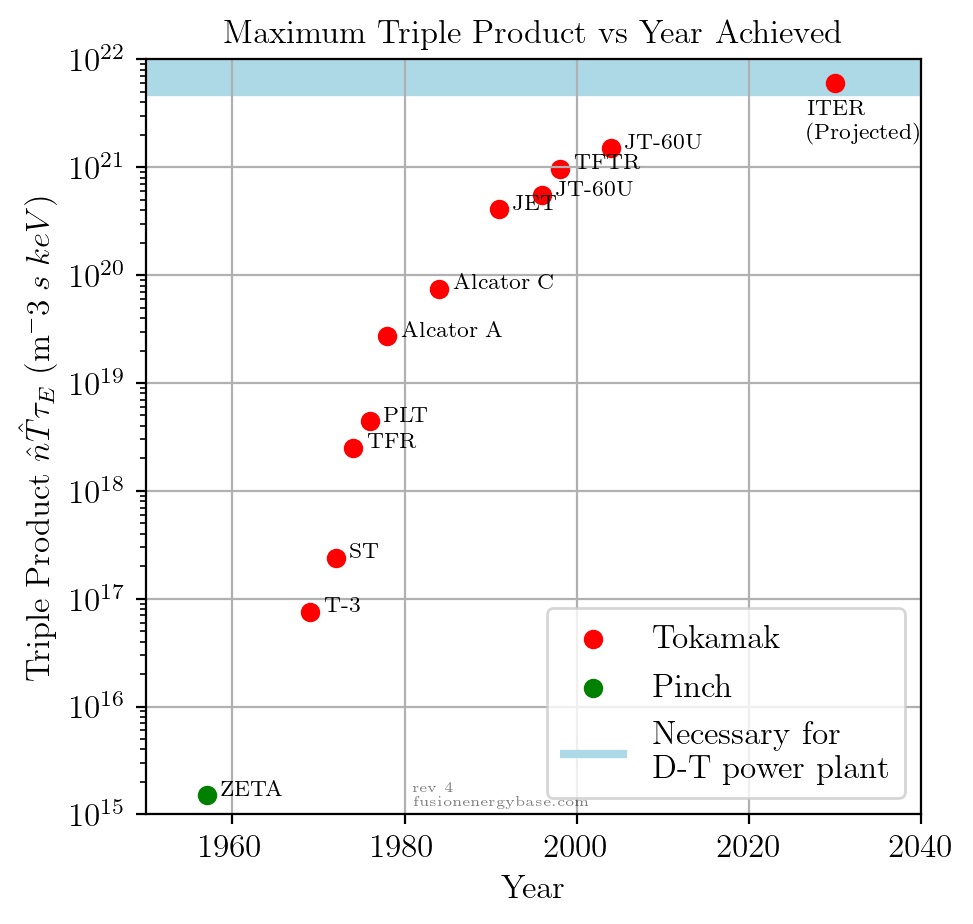
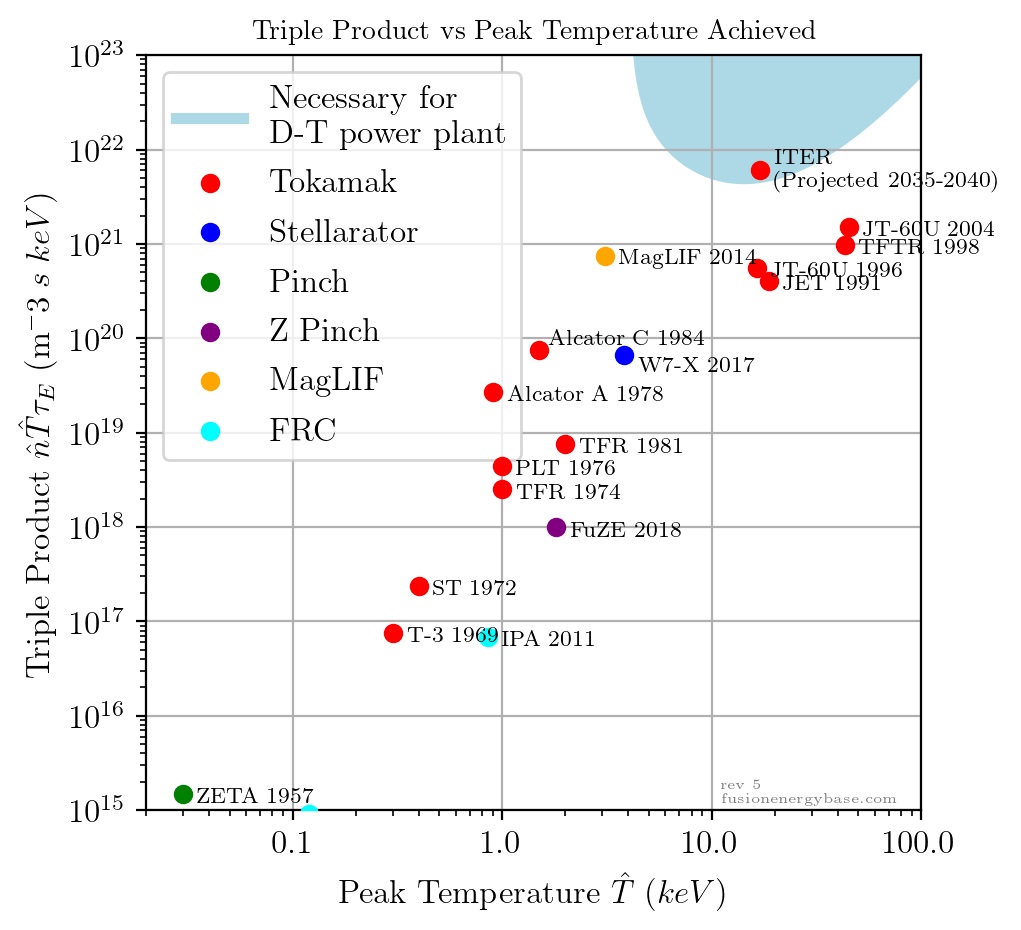
Both graphs are from an excellent website.
A few points to note related to these two graphs:
- Nuclear fusion has been achieved in the labs. They have even produced more energy than was required to achieve the fusion. It just isn't sufficient yet for a nuclear power plant.
- The physicists have achieved temperatures above 50 million degrees!
- The physicists have achieved sustained temperatures and plasma density for up to 1000 seconds!
- The statement that fusion power is always 40 years in the future ignores the incredible progress that has been made. It is going to be achieved.
What will it mean for the World to have all the energy we need, without relying on coal, oil, or gas as energy sources? We will always need oil, gas, and coal, but not as major energy sources. Their value for plastics, chemicals, and fertilizer will be far more important. I don't for a moment pretend that energy sufficiency is all gain and no downside. Nothing in life is so, and this will be no different. But an abundance of energy will solve many of the problems we face as nations. Currently every major power and every wannabe nation jockeys for an advantageous position relative to securing ample energy supplies (oil) for their future. This unending quest is the cause of much international tension and savagery. Nuclear fusion when it reaches production level, could end this struggle. Sounds almost too good to be true. But we had better hope it is true. The outcome of it not being true is increased world tension as nations vie for the ever scarcer energy sources.
-- mof, 11/24/2026